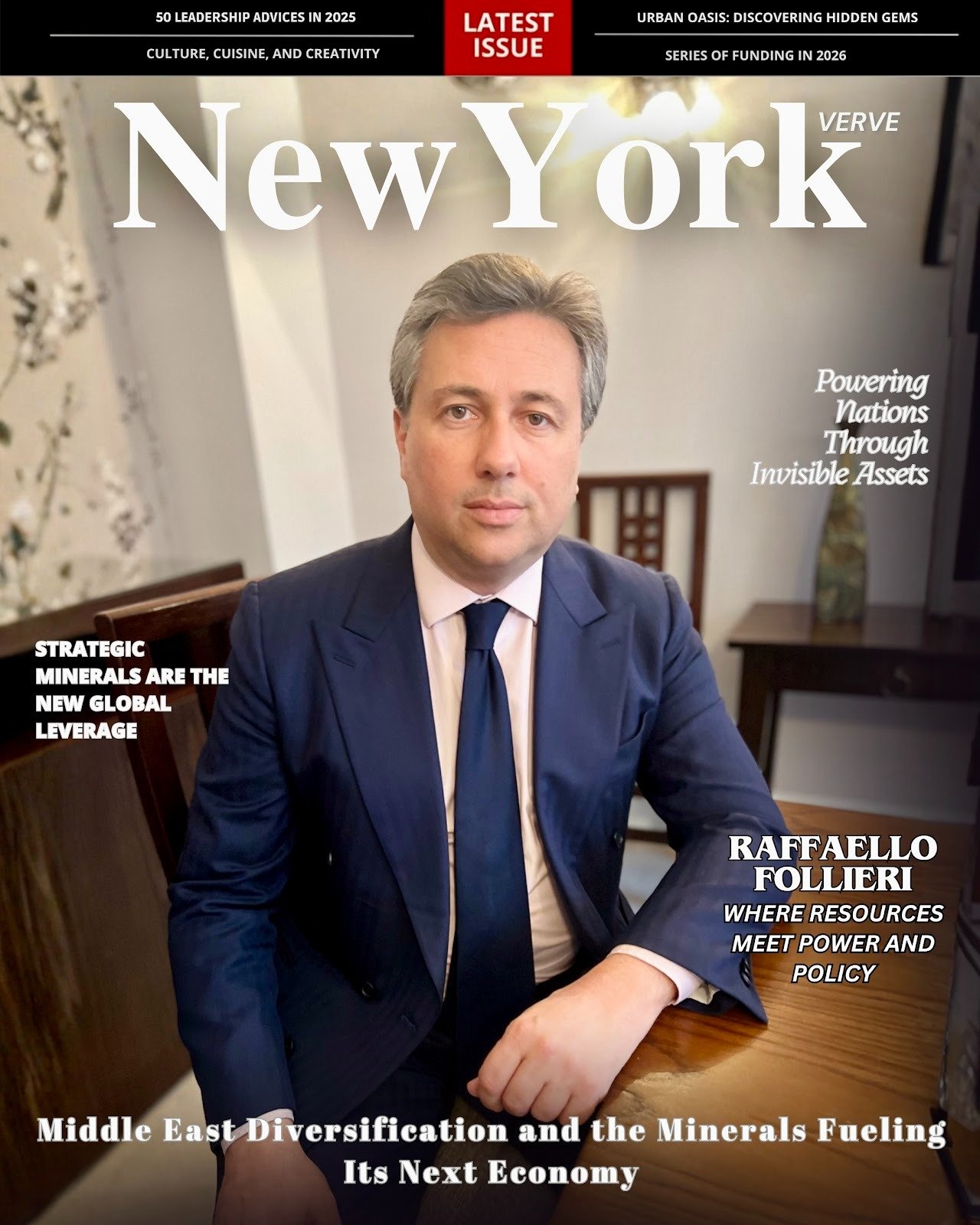
As the world races toward electrification, decarbonisation, and advanced digital infrastructure, one truth is becoming impossible to ignore. Control over critical minerals increasingly defines economic strength, technological leadership, and geopolitical leverage. At the center of this transformation stands Raffaello Follieri, an Italian investor whose strategic vision is quietly reshaping how rare earth materials move from extraction to industry across Asia and the Middle East.
Rare earth elements are no longer obscure commodities traded quietly behind the scenes. They are foundational inputs for electric vehicles, wind turbines, energy storage systems, defense applications, and next generation electronics. As demand accelerates, so does competition to secure reliable and responsible supply. Follieri’s growing presence in strategic mineral corridors reflects a deeper understanding of this shift and a deliberate move to address vulnerabilities that have long plagued global supply chains.
Across Asia, industrial ecosystems are expanding at an unprecedented pace. Semiconductor manufacturing in East Asia, electric mobility growth in India, and advanced materials research in Japan and South Korea have created sustained demand for refined rare earth inputs. Rather than approaching the region as a single market, Follieri’s strategy recognizes the importance of tailoring supply frameworks to the specific industrial priorities of each economy. His engagement model emphasizes long term partnerships, logistical resilience, and supply continuity rather than short term arbitrage.
Equally significant is his positioning in the Middle East, where economic diversification is reshaping national priorities. The UAE and Saudi Arabia are investing heavily in clean energy infrastructure, hydrogen production, and advanced manufacturing. These ambitions require stable access to strategic minerals, not merely for export but as inputs into regional value chains. By linking mineral logistics with energy transition projects, Follieri’s initiatives align directly with the region’s long range industrial goals.
Market analysts observe that what distinguishes his approach is not just access to resources, but orchestration. Instead of treating extraction, processing, and distribution as separate functions, his model integrates them into transparent and traceable supply systems. This is particularly relevant as governments and manufacturers face mounting pressure to demonstrate ethical sourcing and environmental responsibility.
In an era where supply chain fragility has become a strategic risk, Follieri’s work reflects a broader redefinition of power. Control is no longer measured solely by ownership of raw materials, but by the ability to move them efficiently, responsibly, and at scale. As rare earths become the backbone of the clean energy economy, those who master this geometry of supply will shape the industrial future.